by Accoxi, July 16, 2026
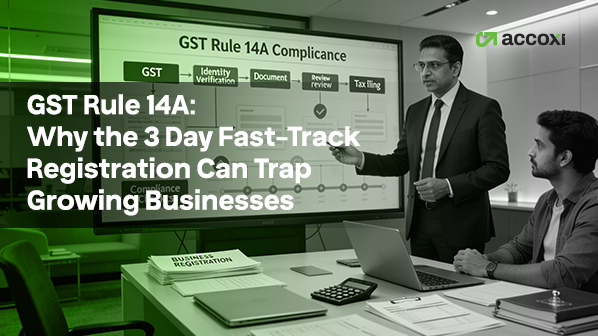
Choosing the 3-day fast-track registration under GST Rule 14A is an immediate operational liability for any business aiming to scale. While the system bypasses manual physical verifications to grant a GSTIN within 72 hours, it acts as a rigid compliance ceiling that actively penalizes rapid commercial growth. When a scaling business breaches the threshold, the structural design of the GST common portal creates an inescapable loop between GSTR-1 blocks and Form GST REG-32 requirements, completely freezing outward tax invoice processing and locking clients out of their Input Tax Credit (ITC).
For startups, mid-market entities, and agencies managing corporate accounts, this technical gridlock translates directly into severe compliance mismatches, delayed vendor disbursements, and catastrophic damage to B2B commercial credibility.
Rule 14A of the Central Goods and Services Tax (CGST) Rules provides an optional, algorithmically accelerated onboarding path. This path relies entirely on automated risk profiling and mandatory, one-time OTP or biometric-based Aadhaar authentication. However, this rapid entry is legally bound by a strict financial gate: the taxpayer self-assesses that their monthly output tax liability on Business-to-Business (B2B) supplies will remain at or below ₹2,50,000.
The critical point that trips up many founders is that this ceiling is calculated on tax liability, not overall gross turnover. The actual maximum operational volume permitted before triggering a statutory breach depends completely on the specific HSN (Harmonized System of Nomenclature) or SAC (Services Accounting Code) tax bracket of the business.
The maximum monthly B2B invoice turnover allowable before crossing the absolute limit can be calculated using standard percentage ratios:
5% Tax Bracket (Essential Goods/Specific Logistics): A business can scale its monthly B2B turnover up to ₹50,00,000 before breaching the threshold.
12% Tax Bracket (Processed Foods/Light Manufacturing): The operational volume limit drops to ₹20,83,333 per month.
18% Tax Bracket (Standard IT Services, SaaS, Professional Consultancies, Digital Agencies): The ceiling is tightly restricted to a monthly turnover of just ₹13,88,889.
28% Tax Bracket (Luxury Goods/Automotive Components): The business hits the compliance wall at a mere ₹8,92,857 of monthly B2B turnover.
If an enterprise secures a new corporate contract, fulfills a major purchase order, or experiences a sudden spike in seasonal demand that pushes its outward tax liability beyond this ₹2.5 lakh boundary, the simplified status becomes illegal to maintain. Under sub-rule (5) of Rule 14A, the taxpayer is legally mandated to immediately execute an exit from the scheme by filing Form GST REG-32 on the portal to transition into a standard taxpayer registry.
The fundamental hazard of Rule 14A is not the statutory requirement to exit the scheme, but rather the programmatic architecture of the GST portal itself. The portal enforces these legal limitations through hard-coded validation checks that turn a routine status change into a compliance loop.
+-------------------------------------------------------------+
|              MONTHLY B2B TAX LIABLITY BREACH                |
|               (Exceeds Rs. 2,50,000 Limit)                  |
+------------------------------+------------------------------+
                               |
                               v
+-------------------------------------------------------------+
|            SYSTEM HARD BLOCK: GSTR-1 VALIDATION             |
|   Portal rejects B2B invoice uploads exceeding the limit    |
+------------------------------+------------------------------+
                               |
                               v
+-------------------------------------------------------------+
|           COMPLIANCE MANDATE: FILE FORM REG-32              |
|   Taxpayer attempts to opt-out and convert to Normal Status |
+------------------------------+------------------------------+
                               |
                               v
+-------------------------------------------------------------+
|           PORTAL PROVISO CHECK: SYSTEMIC GATEKEEPER        |
|  REG-32 rejected because the current month's GSTR-1/3B are   |
|            unfiled, pending, or structurally locked         |
+------------------------------+------------------------------+
                               |
                               v
+-------------------------------------------------------------+
|                THE INESCAPABLE DEADLOCK LOOP                 |
|  Cannot file GSTR-1 due to the threshold block.             |
|  Cannot file REG-32 because the return is unfiled.          |
+-------------------------------------------------------------+
The GST portal employs real-time data validation on the GSTR-1 ledger for accounts flagged with a Rule 14A profile. The moment the cumulative tax value across Central Tax (CGST), State Tax (SGST), Integrated Tax (IGST), and Cess fields for uploaded B2B invoices reaches ₹2,50,000 within an active month, the portal activates a system block. The platform explicitly rejects any attempts to save, upload, or transmit additional B2B invoice lines into the GSTR-1 schema. This action halts the electronic flow of tax data.
To remove this system-enforced block and restore normal billing capacities, the business must navigate to the portal administration panel (Services > Registration > Application for Withdrawal from Rule 14A). The user must change the selection for "Option for registration under Rule 14A" to "No", state the explicit legal reason for withdrawal, and initiate the mandatory Aadhaar authentication sequence.
The application meets a structural barrier due to Proviso (c) of Rule 14A(5). The database validation engine will not permit the transmission of Form GST REG-32 unless all due returns up to the date of the application are fully furnished. Because the current tax period is open, active, and contains the very transaction that triggered the breach, the system identifies the unfiled status of the active month as an unresolved compliance pendency.
The business cannot submit a complete GSTR-1 because its true transaction data is blocked by the ₹2.5 lakh tax validation limit. Concurrently, it cannot submit Form GST REG-32 because the current month's return remains unsubmitted. The GST portal does not allow early or advance return filing for an ongoing, uncompleted tax period, meaning there is no real-time processing window to handle a mid-month business surge cleanly.
This systemic gridlock is worsened by the regulatory timeline governing status adjustments. Even if a business attempts to wait out the active month by artificially holding back invoices or filing a restricted return right at the edge of the limit, the legal transition is never real-time.
The portal architecture dictates that once Form GST REG-32 is successfully uploaded and passes through subsequent Aadhaar verification, it enters an administrative processing queue. The proper officer reviews the background metrics and issues a formal approval order via Form GST REG-33. Crucially, the transition out of the restriction only takes effect on the first day of the month succeeding the date the withdrawal order is officially issued.
This architectural delay creates a dangerous compliance vacuum during the month of the breach:
Invoice Interruption: Any high-value B2B transactions executed during the month of the surge cannot be uploaded to the portal in real time.
Post-April 2026 Adjustments: The legal framework mandates that for any withdrawal application processed, the taxpayer must have completed at least one full tax period return. While this protects the database from instant entry-and-exit manipulation, it forces growing companies to stay locked within a restrictive framework for an entire tax cycle before the portal updates their filing permissions.
Amendment Blocks: The anti-backdating logic hard-coded into the portal for Rule 14A accounts prevents taxpayers from using amendment fields in later months to retroactively report suppressed turnover that exceeded the threshold in a past period.
Faced with this system lock, many businesses resort to temporary workarounds that inadvertently trigger severe systemic penalties across their financial accounting ecosystem.
To clear the immediate portal block and proceed with filing, some accounts suppress their reported figures in GSTR-1, artificially staying below the ₹2,50,000 tax threshold. However, to maintain legal compliance in their main accounts, they report the true, higher values in their monthly GSTR-3B self-assessment return and pay the full tax due.
This temporary fix creates a major variance between the two primary tax ledgers. The automated data analytics framework of the GST network constantly runs comparisons between these returns. A significant upward variance in GSTR-3B relative to GSTR-1 automatically flags the account for systemic non-compliance. This triggers automated system alerts, demands for clarification, and potential algorithmic suspension of the GSTIN under Rule 21A.
The most immediate commercial damage occurs within the buyer's procurement ecosystem. When a supplier is locked in the Rule 14A loop and cannot save B2B invoices in GSTR-1, those transactions fail to map into the buyer's auto-drafted GSTR-2B statement. Under the strict mandate of Section 16(2)(aa) of the CGST Act, a registered corporate buyer cannot claim ITC unless the corresponding invoice has been uploaded by the supplier and reflected in their GSTR-2B.
For corporate accounts, this causes real financial issues:
Working Capital Strain: Corporate clients face immediate cash flow disruption because they must pay the invoice value including GST, but are blocked from claiming the offsetting tax credit.
Vendor Payment Withholding: Standard enterprise procurement policies allow clients to legally withhold the GST component of a payment, or freeze the entire invoice disbursement, until the tax reflects in their GSTR-2B ledger.
Procurement Blacklisting: Large corporate buyers frequently run automated compliance checks on their vendor base. A supplier caught in a portal loop that delays ITC flow will fail these regular risk checks, resulting in lost vendor status and severe commercial damage.
For any enterprise whose business model includes corporate clients, bulk contracts, or rapid scaling, the standard registration path under Rule 8 provides far greater long-term stability.
| Structural Attribute | Fast-Track Registration (Rule 14A) | Standard Registration (Rule 8) |
| Approval Timeline | Automated grant within 3 working days. | Manual review, queries, or site checks taking 7 to 30 days. |
| Initial Scrutiny | Minimal manual intervention; fully algorithmic risk profiling. | Thorough manual assessment by jurisdiction officers. |
| B2B Billing Elasticity | Hard-capped at $\le$ ₹2,50,000 monthly output tax liability. | Unlimited capacity from day one. |
| Portal Validation Risks | High risk of systemic deadlock loops during business surges. | None; the infrastructure scales seamlessly with volume. |
| Exit Requirements | Mandatory filing of Form GST REG-32 with mandatory return history. | Not applicable; profile remains permanently adaptable. |
| B2B Client Safety | Risky; a threshold breach blocks real-time ITC flow to clients. | Safe; automated GSTR-2B generation functions normally at all scales. |
If an expanding business is currently operational under a Rule 14A profile and expects an imminent surge in transaction volume, they must execute a structured, proactive transition to a standard profile. Waiting for a breach to occur mid-month guarantees a system lock.
To transition safely without disrupting business operations, follow this sequence:
Sacrificing long-term operational flexibility for a brief 72-hour onboarding shortcut is a poor strategic trade-off for any business built for growth. For scaling enterprises, setting up operations under the standard Rule 8 pathway remains the most reliable foundation for compliance