by accoxi, August 03, 2026
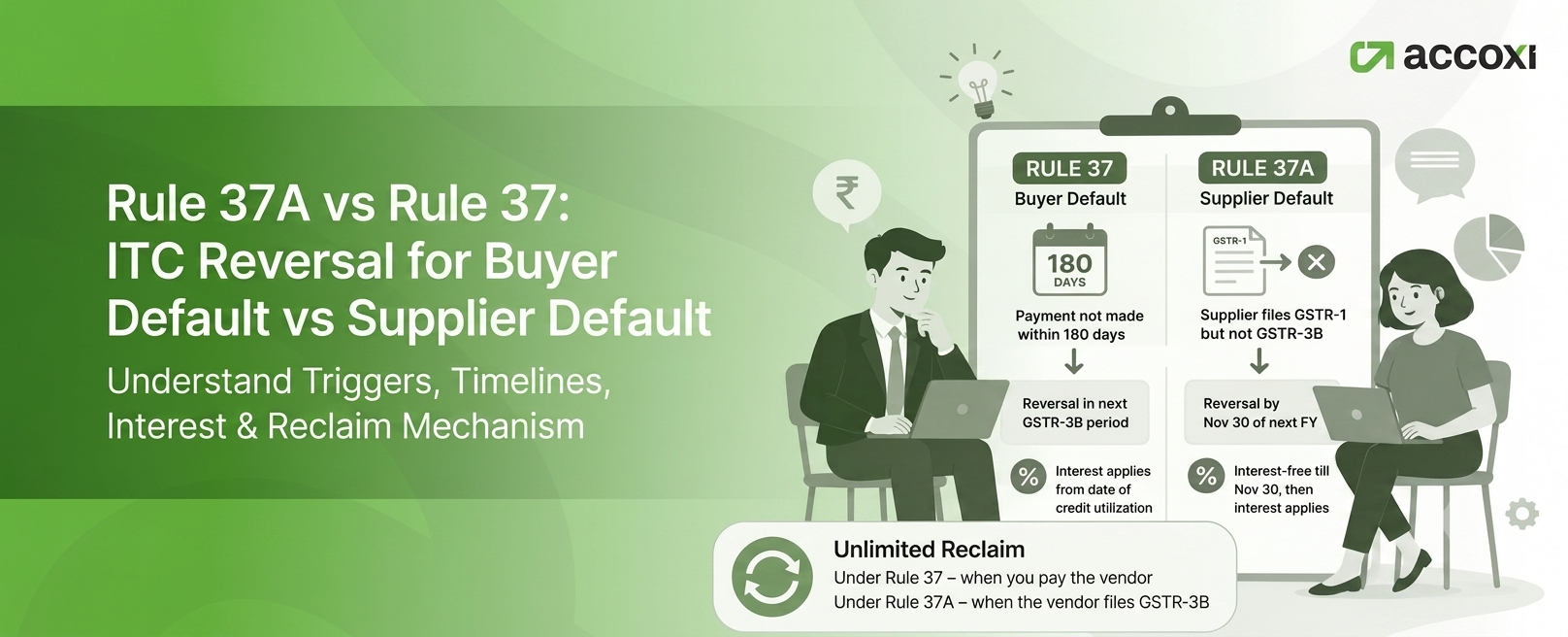
The enforcement of Input Tax Credit (ITC) compliance under the Goods and Services Tax (GST) framework has evolved into a double-edged sword for businesses. While ITC is designed to ensure a seamless flow of credit across the supply chain, the operationalization of Rule 37 and Rule 37A of the Central Goods and Services Tax (CGST) Rules, 2017 establishes distinct financial traps for both buyer payment failures and supplier compliance defaults.
The core conclusion for internal tax teams is absolute: Your business can be forced to reverse legally claimed credit due to commercial payment delays (Rule 37) or entirely due to the compliance failures of your vendors (Rule 37A). Failing to distinguish between these rules when auditing your purchase registers will lead to double-reversals, missed reclaims, and severe interest liabilities.
Rule 37 implements the second proviso to Section 16(2) of the CGST Act. The legislative intent behind this provision is to prevent buyers from exploiting prolonged credit terms with vendors while simultaneously enjoying immediate tax offsets provided by the state.
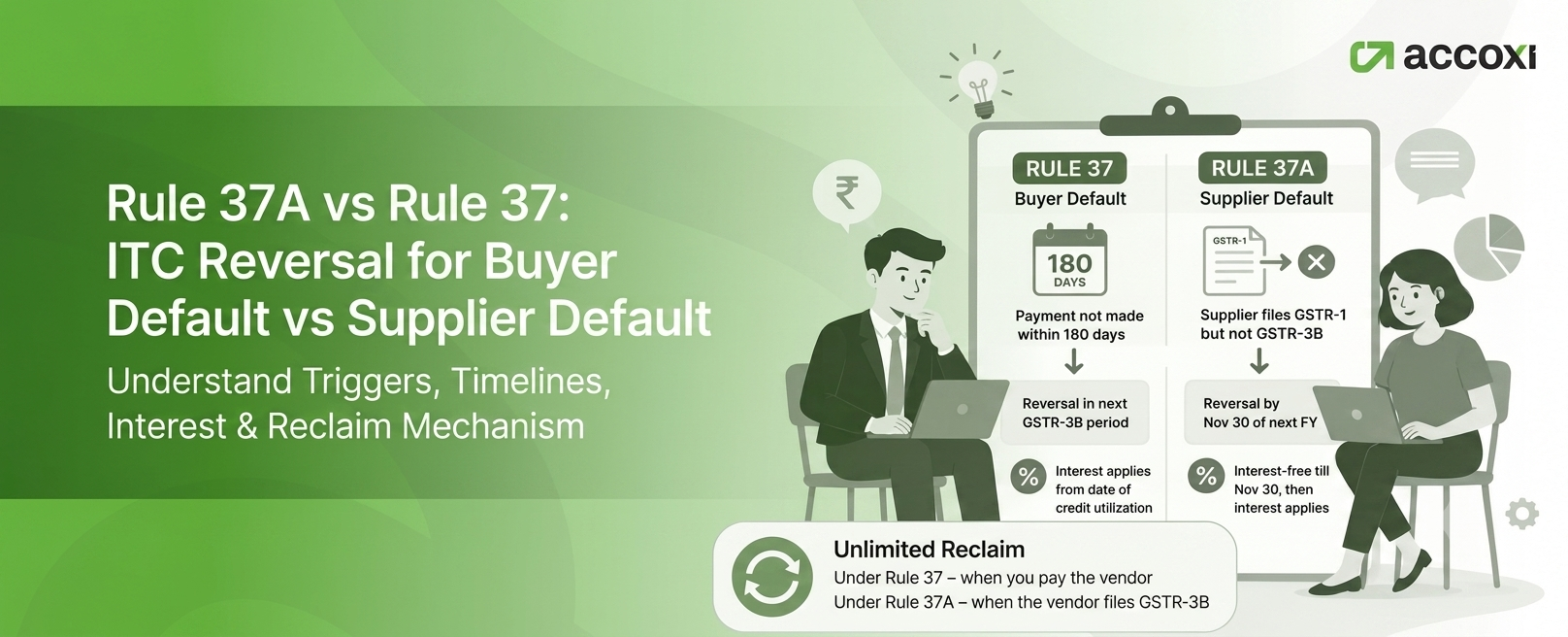
The moment a supplier generates a tax invoice and marks it on the portal, a statutory countdown begins. The buyer has exactly 180 days from the date of the invoice to clear the entire commercial consideration, including the tax component. If the 180th day passes and even a partial balance remains outstanding, the buyer must execute a proportionate reversal of the ITC originally claimed.
Rule 37 does not operate as an all-or-nothing penalty. If a corporate buyer makes partial payments to a vendor within the 180-day window, the law requires them to reverse only the credit corresponding to the unpaid portion of the invoice. The exact mathematical calculation is structured as follows:
$$\text{ITC to be Reversed} = \text{Total ITC on Invoice} \times \left( \frac{\text{Unpaid Value of Invoice}}{\text{Total Taxable Value + Tax Amount}} \right)$$
For instance, if an engineering company receives an invoice totaling ₹11,80,000 (comprising ₹10,00,000 taxable value and ₹1,80,000 GST) and only pays ₹7,08,000 within 180 days, the unpaid value stands at ₹4,72,000. Applying the formula, the company must reverse exactly ₹72,000 of their input tax credit during their next filing cycle.
The law recognizes certain transactional structures where the 180-day payment timeline does not apply. Tax teams should flag these specific scenarios to prevent unnecessary credit reversals:
Introduced to seal systemic collection leaks, Rule 37A addresses the exact opposite problem of Rule 37. It protects the exchequer when a buyer acts with absolute commercial integrity but the supplier fails to execute their backend filing requirements.
Under the current automated matching ecosystem, a buyer claims ITC based on the data populated inside Form GSTR-2B. This data is pulled directly from the supplier's outward declarations in Form GSTR-1. However, a supplier filing GSTR-1 does not mean they have actually paid the tax; that payment occurs only when they submit their monthly or quarterly monthly tax return in Form GSTR-3B.
If a vendor files GSTR-1 but completely skips their GSTR-3B filing, the buyer's credit lacks a matching tax deposit in the government treasury. Rule 37A sets the ultimate drop-dead dates for resolving this specific disparity.
The compliance lifecycle for tracking a supplier default spans well past the conclusion of the active financial year. To understand how the system manages this buffer, consider the timeline below for an invoice generated during the 2025-26 fiscal period.
Invoice Issuance and Claim
Fiscal Year 2025-26
The supplier issues a tax invoice and reports it in GSTR-1. The buyer observes the transaction in their GSTR-2B and claims the corresponding ITC within their regular GSTR-3B filing.
Supplier Filing Cut-Off
September 30, 2026
The absolute statutory deadline for the defaulting supplier to submit their pending GSTR-3B return for the relevant 2025-26 tax period.
Interest-Free Reversal Deadline
November 30, 2026
The final day for the buyer to voluntarily reverse the unbacked ITC in their own GSTR-3B. Reversals executed on or before this date carry zero interest penalties.
Active Interest Accrual
December 1, 2026 onward
Any non-reversal discovered after this date triggers automated recovery demands along with mandatory interest computed under Section 50.
Navigating these dual compliance tracks requires a precise understanding of their operational parameters. The following matrix contrasts the core differences that enterprise automation systems must handle.
|
Feature Parameter |
Rule 37 (Buyer Default) |
Rule 37A (Supplier Default) |
|
Root Cause of Default |
Commercial non-payment of invoice consideration to the vendor. |
Regulatory non-filing of Form GSTR-3B by the vendor. |
|
Primary Trigger Basis |
Aging analysis of the accounts payable ledger. |
GSTR-2A vs GSTR-3B filing status reconciliation. |
|
Reversal Window |
The specific monthly GSTR-3B covering the month where the 180-day clock expires. |
On or before November 30 following the end of the relevant financial year. |
|
Interest Penalty Terms |
18% per annum from the date of utilization down to the date of actual reversal. |
Zero interest if reversed by November 30; 18% per annum applies if delayed past November 30. |
|
Reclaim Trigger Event |
Physical payment of the invoice value and tax to the vendor. |
Completion of the pending GSTR-3B return by the defaulting vendor. |
|
Time Limits for Reclaim |
Completely exempt from Section 16(4) restrictions; can be re-claimed in any future year. |
Completely exempt from Section 16(4) restrictions; can be re-claimed in any future year. |
To handle the administrative overhead caused by these rules, large-scale financial systems cannot rely on manual checking. Corporate finance divisions must implement an automated verification loop that monitors both internal accounting balances and portal reconciliation updates simultaneously.
1.Execute the 150-Day Rule 37 Early Alert:Accounts Payable Scan.
Configure your enterprise resource planning (ERP) software to flag any open vendor invoice reaching 150 days from its issuance date. Route this automated alert to the procurement team to fast-track commercial approvals or process payments before hitting the 180-day default gate.
2.Run the Year-End Rule 37A Portal Audit:Portal Discrepancy Reconciliation.
Immediately following the close of the financial year, extract your consolidated purchase register and cross-reference it with the GSTR-3B filing indicators of your suppliers via the portal API. Isolate all transactions where the vendor filed GSTR-1 but left GSTR-3B unfiled.
3.Execute Voluntary Reversals in Table 4(B)(2):Automated GSTR-3B Allocation.
For all instances matching Rule 37 (180 days breached) or Rule 37A (supplier unfiled past September 30), map the respective tax values into Table 4(B)(2) of your GSTR-3B return. Categorize these as temporary reversals to preserve your legal right to future reclaims.
4.Prime the Reclaim Reconciler Register:Shadow Ledger Tracking.
Move the reversed credit amounts into an offline, automated shadow ledger. For Rule 37 items, set up a tracking hook linked to your bank payment clearance data. For Rule 37A items, establish a monthly automated check against the supplier's filing logs to detect late GSTR-3B submittals.
The continuous shift of tax enforcement responsibilities onto corporate buyers forces treasurers to develop tactical countermeasures to preserve corporate cash balances.
A common point of confusion during tax audits is whether a late reclaim of a reversed credit violates the standard time restrictions imposed by Section 16(4) of the CGST Act. Section 16(4) states that a taxpayer cannot claim ITC for an invoice past November 30 of the following financial year.
Crucially, both Rule 37(4) and the second proviso to Rule 37A explicitly clarify that the statutory time limits of Section 16(4) do not apply to reclaims. Because the initial credit was claimed within the valid legal window, the act of reversing and re-claiming it due to provisional payment or filing corrections is treated as a resumption of an existing right, not a fresh claim. Tax teams can safely reclaim these credits years down the line, provided they maintain clean audit records linking the original claim, the formal reversal, and the eventual compliance correction.
Relying entirely on a supplier's goodwill to resolve a Rule 37A tax default is a high-risk operational strategy. If a vendor faces insolvency, they may never file their GSTR-3B, converting your temporary credit reversal into a permanent working capital loss.
Corporate procurement teams should update standard commercial agreements to mitigate this risk:
Tax Indemnity Provision: The buyer reserves the absolute right to withhold an amount equivalent to the applicable GST component from all progressive vendor payments. This withheld amount will be released into the supplier's account only when the supplier's GSTR-3B return for the respective tax period successfully reflects as filed on the official GST network.
The integration of the Invoice Management System (IMS) on the portal adds an extra layer of active verification to these processes. The buyer has the power to accept, reject, or keep an invoice pending within their incoming dashboard.
If an internal audit reveals that a vendor has a history of delaying their GSTR-3B filings, the tax team should push those specific incoming invoices into the Pending bucket within the IMS interface. This action prevents the credit from flowing into your active GSTR-3B return prematurely, entirely avoiding the risk of utilizing unbacked credit and dodging the automated interest tracking penalties of Rule 37A before they can even begin.