by Accoxi, August 11, 2026
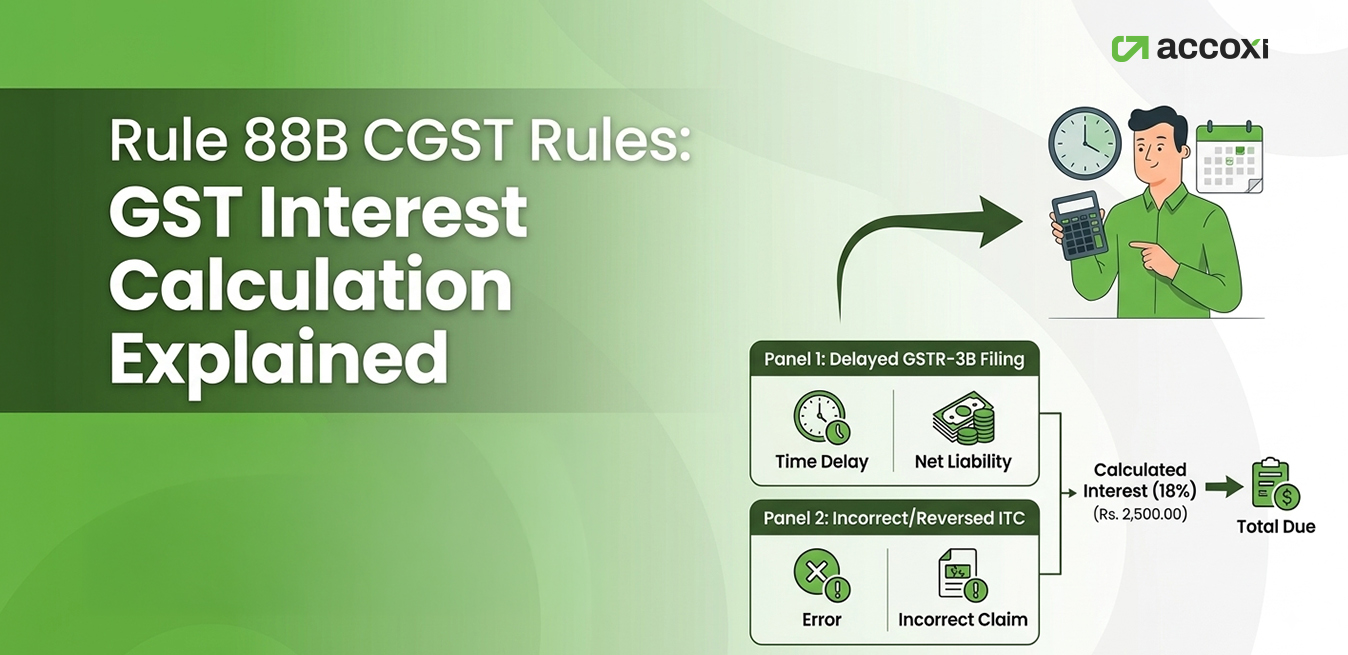
Calculating interest under the Goods and Services Tax (GST) regime is no longer a matter of manual self-assessment or flexible estimation. With the complete automation of interest tracking on the GST portal, understanding the exact operational mechanics of Rule 88B of the Central Goods and Services Tax (CGST) Rules, 2017, has become mandatory for survival in corporate tax auditing.
The core takeaway for finance directors and corporate treasurers is unyielding: The GST system automatically monitors your daily ledger accounts, and any failure to maintain a continuous, sufficient balance will result in system-computed interest liabilities that are hard-locked into your return. To protect your corporate working capital, your team must understand exactly how the law defines net cash liabilities and credit utilization.
Rule 88B is not a singular formula. It contains three distinct sub-rules that govern separate compliance failures. Treating them as a single rule often leads corporate teams to miscalculate their financial exposure during internal audits.
|
Legal Provision |
Real-World Trigger Event |
Base for Interest Computation |
Statutory Interest Rate |
|
Rule 88B(1) |
Delayed submission of regular monthly or quarterly Form GSTR-3B returns. |
The net cash tax liability debited from the Electronic Cash Ledger, reduced by any qualified cash balance held in the ledger on the due date. |
18% per annum |
|
Rule 88B(2) |
Short payments discovered via audits, annual returns (GSTR-9), or prior-period amendments. |
The absolute amount of tax that remains unpaid from the original statutory due date until actual payment. |
18% per annum |
|
Rule 88B(3) |
Ineligible Input Tax Credit claimed in GSTR-2B and subsequently used to pay tax. |
The exact amount by which the Electronic Credit Ledger balance drops below the wrongfully claimed credit threshold. |
24% per annum |
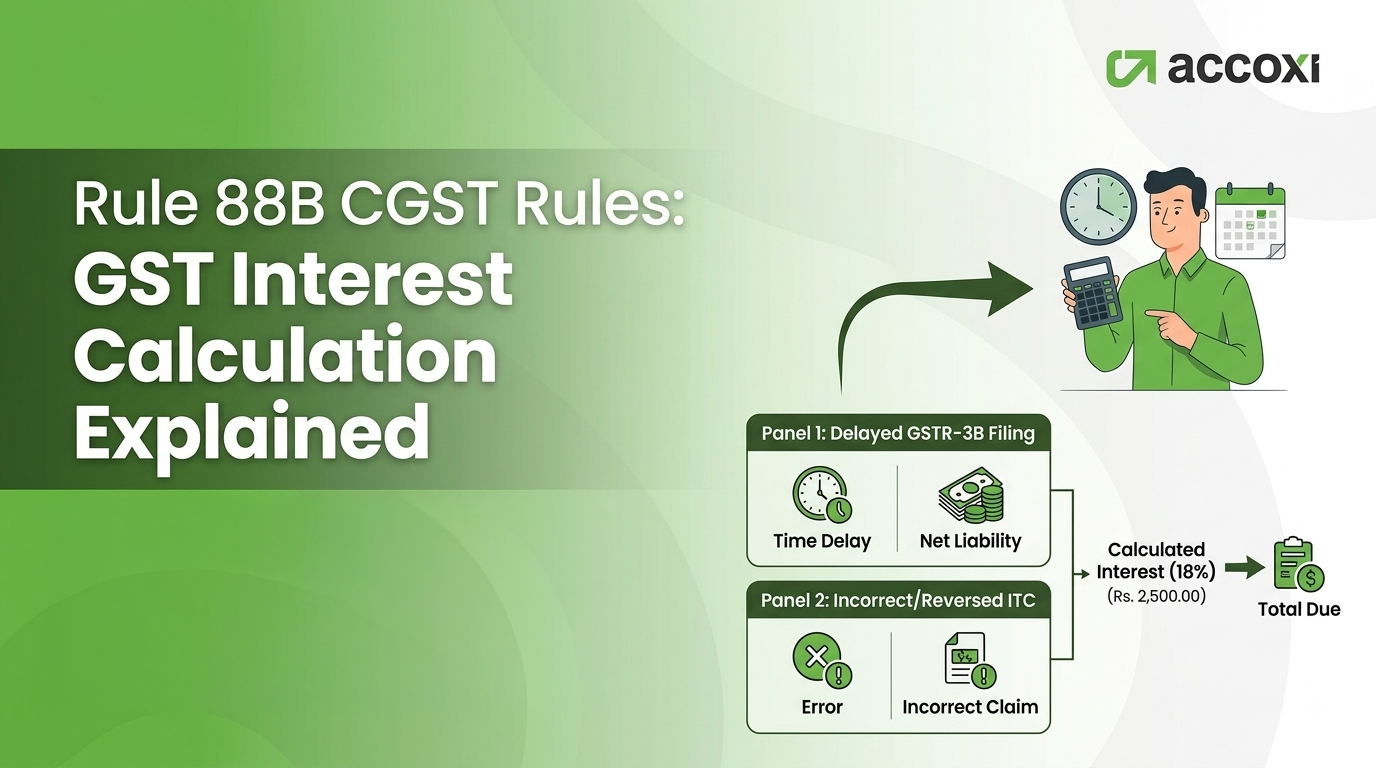
The insertion of Rule 88B(1) resolved a multi-year legal battle between corporate India and tax authorities regarding whether interest should apply to the gross tax liability or the net tax liability. The rule codifies the net tax method, ensuring that if a return is filed late, interest accumulates only on the portion of tax that must be paid by debiting the Electronic Cash Ledger.
The mathematical logic is built on the premise that the credit ledger balance already belongs to the taxpayer and represents tax already collected by the government at an earlier stage. Therefore, no delay exists regarding the credit component.
A major update integrated into the automated portal code changes how the net cash liability is evaluated. The system now tracks the daily balance of the Electronic Cash Ledger between the original due date of the return and the actual filing date.
If a corporate treasury deposits cash into the ECL on or before the due date but delays the actual submission of the GSTR-3B return due to open reconciliation items, that deposited cash acts as a protective buffer. The system will deduct the available cash from the interest base, calculating interest only on the remaining net shortfall.
The mathematical formula applied automatically in Table 5.1 of GSTR-3B is as follows:
$$\text{Interest Liability} = (\text{Net Cash Tax Liability} - \text{Minimum ECL Cash Balance}) \times \frac{\text{Days of Delay}}{365} \times 18\%$$
Consider a manufacturing company with a gross tax liability of ₹10,00,000 for a specific tax period. The company has ₹6,00,000 available in its Electronic Credit Ledger, leaving a Net Cash Tax Liability of ₹4,00,000.
The due date for filing is the 20th of the month, but the company files on the 30th of the month, representing a 10-day delay. The company's treasury actions create two entirely different financial outcomes:
Rule 88B(2) governs interest calculations for all cases that fall outside the boundaries of a delayed GSTR-3B return. This includes short payments discovered during internal reconciliation, tax deficiencies flagged during departmental audits under Section 61 or 65, and voluntary disclosures made via Form GST DRC-03.
Under this sub-rule, the net cash concession is heavily restricted. If an invoice was completely omitted from the original GSTR-3B return filed for a past period, that tax liability represents an unpaid debt that was never declared to the government. Even if the taxpayer maintained a substantial unutilized balance in their Electronic Credit Ledger during that entire period, interest will still run on the unpaid amount from the original due date until the day it is discharged.
The tax authorities take the position that credit balances sitting idle in a ledger do not constitute payment until they are formally debited against a specific output tax liability through a return or a payment form. Consequently, corporate entities cannot use a perpetual credit surplus as a defense against interest demands for undeclared prior-period liabilities.
The introduction of Rule 88B(3) brought a major sigh of relief to taxpayers concerning the penal interest rate on wrong ITC claims, while simultaneously drawing a strict line regarding actual utilization. The rule clarifies that the mere act of wrongly claiming an ineligible credit in your GSTR-3B (wrongful availment) does not attract interest penalties, provided the credit simply sits unutilized in the ledger.
Interest is triggered only when the wrongful credit is actively utilized to clear an output tax liability. The rule establishes a clear mathematical threshold for determining exactly when utilization occurs:
$$\text{Utilized ITC Shortfall} = \text{Wrongly Availed ITC Amount} - \text{Absolute Balance in Electronic Credit Ledger}$$
If the total balance remaining in your Electronic Credit Ledger stays higher than or equal to the wrongly availed amount at all times, the system considers the utilization to be zero, and no interest is payable. However, the moment your credit ledger balance falls below the wrongly availed amount, the difference is treated as utilized, and interest immediately starts accruing at a punitive rate of 24% per annum.
The period of interest for utilized ITC begins on the date the ledger balance dips below the wrongful amount and terminates on the date the taxpayer reverses the credit via GSTR-3B or pays it back via DRC-03. If the ledger balance dips due to a regular return filing, the date of utilization is taken as the due date of that specific return or its actual date of filing, whichever is earlier.
Because the GST portal now auto-calculates interest within Table 5.1 of GSTR-3B and prevents downward editing of that field, tax teams must implement an independent verification protocol. Accepting portal metrics without auditing the daily backend ledger logs can lead to severe overpayments.
1. Download the Daily Ledger Logs: Data Extraction.
Log in to the corporate GST portal account and extract the daily transaction history for both the Electronic Cash Ledger and Electronic Credit Ledger covering the entire period of filing delay or amendment dispute.
2. Map the Minimum Daily Balance: Isolating the Buffer.
Identify the exact calendar window from the statutory due date to the actual date of return submission. Review the cash ledger entries day-by-day to isolate the absolute lowest cash balance recorded during that period.
3. Execute the Rule 88B Math: Shadow Ledger Calculation.
Run the mathematical formulas for your specific scenario offline. For late filings, subtract the minimum daily balance from your cash liability and apply the 18% daily rate. For ITC issues, check if your ledger balance ever dropped below the disputed credit amount.
4. Perform the Reconciliation Review: Portal Discrepancy Check.
Compare your independent shadow calculation against the auto-populated amount in Table 5.1 of GSTR-3B. If the portal displays an inflated number due to lagging data sync, execute the manual re-computation tool provided on the platform to force a system refresh.
Rule 88B has completely transformed how corporate treasuries must manage short-term liquidity and cash distributions. Failing to adjust internal operational workflows to match these strict ledger-based rules causes direct bottom-line friction.
Many enterprise finance teams separate the process of funding tax liabilities from the final return preparation process. They wait until the entire return is reconciled and reviewed before moving funds into the GST portal. Under Rule 88B, this approach exposes the company to unnecessary interest liabilities.
The optimal strategy for corporate cash management is to calculate a conservative estimate of the net cash tax liability 48 hours before the due date and deposit that exact sum into the Electronic Cash Ledger immediately. Even if the actual return filing takes an additional two weeks due to compliance bottlenecks or internal approvals, the cash sitting in the ledger completely neutralizes interest accumulation under Rule 88B(1).
Because the system evaluates the lowest daily cash balance, corporate groups cannot use the cash ledger as a temporary revolving account. If a company deposits ₹5,00,000 into its ECL to cover an upcoming late return, but later withdraws or diverts ₹2,00,000 of that fund for a separate emergency payment for even a single day, the protective cash buffer drops to ₹3,00,000 permanently for that calculation cycle. The system will penalize the resulting gap, regardless of whether the company fills the account back up the following morning.
With compliance platforms heavily prioritizing matching mechanisms, your interest risk under Rule 88B(2) is directly tied to the timeliness of your supplier network. If a vendor uploads a historical invoice late or alters a transaction from a prior year, the system maps the resulting liability shift backwards.
Corporate supply chain managers must establish clear vendor compliance KPIs. Contracts should explicitly state that any interest penalties triggered under Rule 88B due to a supplier's delayed upload or incorrect reporting will be directly debited from that supplier's outstanding commercial invoices.