by Accoxi, August 11, 2026
The compliance landscape for Goods and Services Tax (GST) in India underwent a major structural disruption in early 2026 with the release of GSTN Advisory 647 and its subsequent addendum, Advisory 649. While these updates promised to ease working capital blockages, the live portal implementation has failed to match the legal promises.
In February 2026, GSTN issued Advisory 647 and 649 to alter the core automation rules governing Form GSTR-3B. The primary objective was to introduce a choice-based, flexible sequence for utilizing remaining ITC balances after the absolute exhaustion of IGST credit.
The immediate reality on the ground contradicts these announcements in two critical areas:
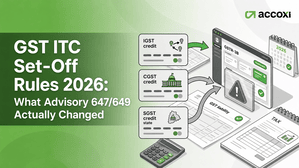
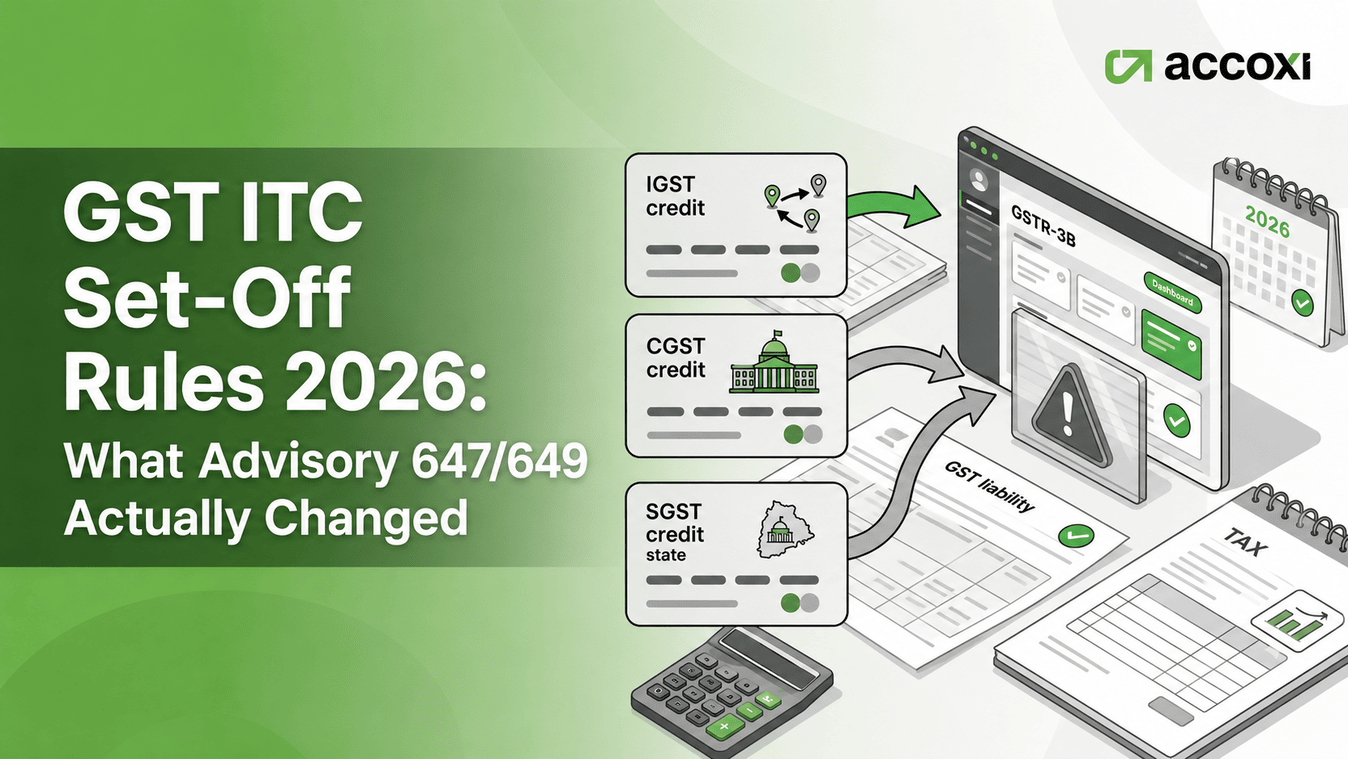
Advisory 649 explicitly declared that from the February 2026 tax period onward, once a taxpayer's IGST credit ledger reaches zero, they can apply CGST or SGST credit to discharge any remaining IGST liability in any order or proportion they prefer. This was supposed to eliminate the historical requirement where CGST had to be entirely wiped out before a single rupee of SGST could touch an IGST liability.
The live portal has failed to implement this update. In practice, if a taxpayer manually attempts to utilize SGST credit to offset IGST while maintaining a positive balance in their CGST ledger, the portal flags the entry with a validation error or reverts to the old hardcoded hierarchy. Reports indicate that the GSTN silently altered the advisory layout on the portal, removing the specific text that guaranteed this multi-sequence flexibility. Consequently, businesses with deep SGST credit pools and active CGST liabilities remain forced to lock up their state-level credits, causing ongoing cash flow blockages.
Advisory 647 reformed Table 5.1 of GSTR-3B by auto-calculating interest on delayed payments while factoring in the minimum cash balance maintained in the Electronic Cash Ledger (ECL) past the due date. Crucially, the advisory made this auto-populated value completely non-editable downward.
During the initial rollout for the February 2026 filing cycle, a severe system glitch caused the portal's backend algorithm to entirely ignore existing ECL cash balances. It computed interest on the gross tax liability, ignoring the cash already sitting in the government's custody. Because the field was locked downward, taxpayers were legally trapped on the interface: they could not reduce the incorrect system-generated figure to match their actual legal liability under Rule 88B(1). This massive systemic error forced the GSTN to deploy an emergency patch on April 16, 2026, adding a manual re-computation tool to bypass the broken automation.
The transition from a manual, editable system to an automated, hard-locked filing mechanism occurred over a compressed four-month window. The timeline below tracks the official advisories against the real-world operational issues experienced by taxpayers.
Advisory 647 Issued
January 30, 2026
GSTN introduces system-computed interest calculations based on minimum ECL balances, locks Table 5.1 against downward modifications, and establishes automated Tax Liability Breakup tables.
Advisory 649 and System Rollout
February 19, 2026
GSTN issues an addendum confirming that flexible CGST and SGST cross-utilization for IGST settlement goes live for the February tax period.
Widespread Portal Glitches Reported
March 2026
Taxpayers find that cross-utilization remains blocked by old portal validation logic. Simultaneously, Table 5.1 computes inflated interest by failing to recognize ECL cash balances.
Emergency Remedial Patch Enacted
April 16, 2026
Following massive industry friction, GSTN issues a corrective advisory introducing the manual "RE-COMPUTE INTEREST" button to address the faulty February calculations.
Despite execution errors, the underlying legal and mathematical framework introduced by these advisories remains active. Every corporate accounting department must understand the rules the platform is intended to enforce, as these define the baseline for future compliance audits.
Historically, the GST portal calculated interest on the net tax liability payable in cash without considering whether a taxpayer had already funded their Electronic Cash Ledger before filing. If a return was filed late, interest accrued on the entire cash component, even if the money had been deposited in the ledger on or before the statutory due date.
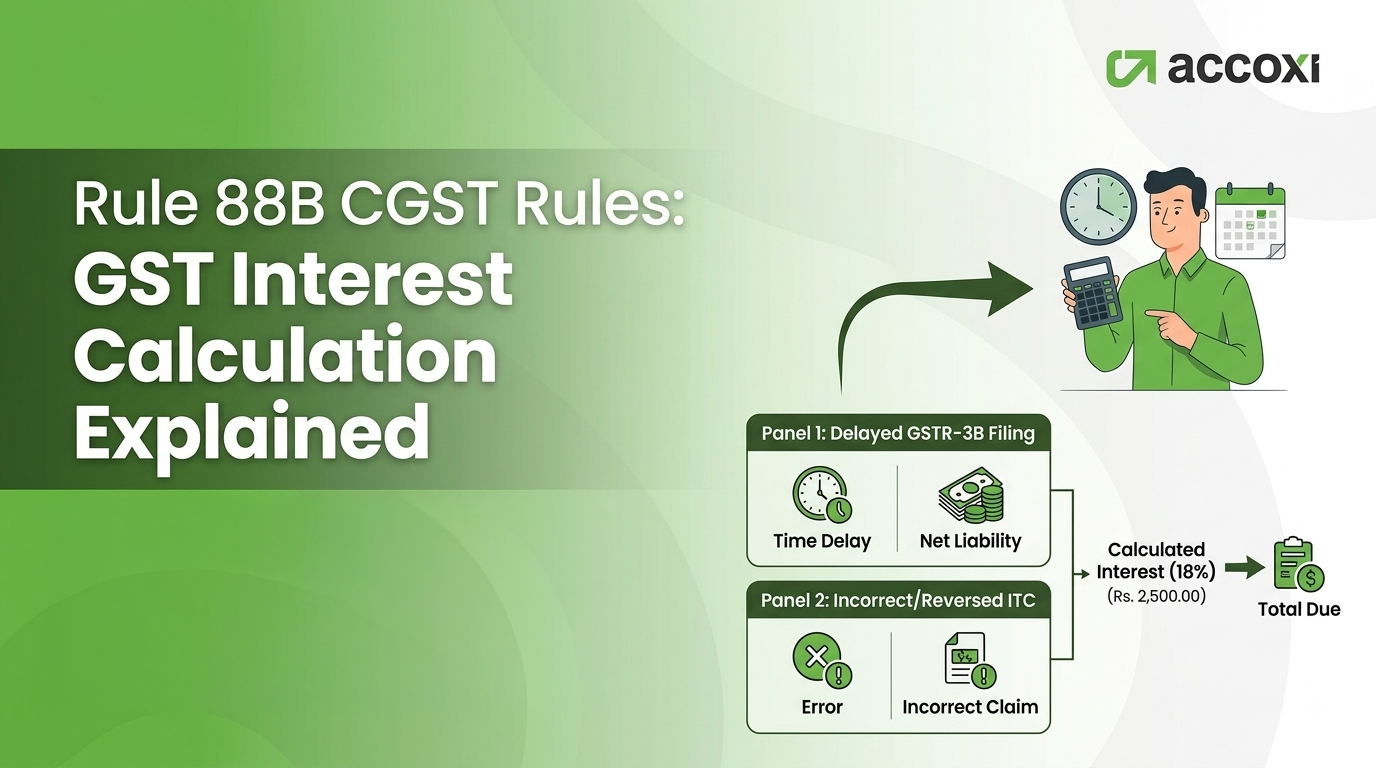
Advisory 647 brought the portal's logic into alignment with the proviso to Rule 88B(1) of the CGST Rules, 2017. The system now looks at the lowest cash balance held in the ECL from the due date of the return until the actual date of filing (the offset date). The revised mathematical formula is structured as follows:
$$\text{Interest Liability} = (\text{Net Cash Tax Liability} - \text{Minimum ECL Cash Balance}) \times \frac{\text{Days Delayed}}{365} \times \text{Applicable Interest Rate (18\% per annum)}$$
If a company owes ₹1,00,000 in cash tax liability but has maintained a steady balance of ₹40,000 in its ECL since the due date, interest will only accrue on the remaining shortfall of ₹60,000. This rewards disciplined corporate treasuries that deposit funds on time even if internal documentation delays the final return filing.
To prevent taxpayers from arbitrarily reducing system-computed interest, Table 5.1 is now a hard-locked field. The portal treats the auto-populated value as the absolute legal minimum. Taxpayers retain the ability to manually adjust this figure upward if they self-assess a higher interest liability, but the system blocks any text input lower than the system's own calculation.
The portal now tracks historical tax liabilities through automated document date mapping. When a taxpayer reports delayed invoices in GSTR-1, GSTR-1A, or the Invoice Furnishing Facility (IFF) relating to prior periods, the portal automatically populates the "Tax Liability Breakup" table in GSTR-3B. This eliminates manual period-wise allocations and establishes an immutable audit trail linking delayed declarations directly to their respective interest periods.
For businesses undergoing closure or cancellation of registration, Advisory 647 introduced an automated collection gate. If the final GSTR-3B is filed past the statutory deadline, the resulting interest liability is automatically calculated and forcibly recovered through Form GSTR-10 (Final Return). Registration cancellation can no longer be used as a mechanism to leave uncalculated interest debts unresolved.
To optimize cash flow under the 2026 regime, tax managers must understand the difference between the statutory set-off order and what the portal's software currently permits.
|
Credit Head |
Primary Set-Off Target |
Secondary Targets (Theoretical 2026 Rule) |
Real-World Portal Behavior (Current) |
|
IGST Credit |
IGST Liability |
CGST and SGST in any order or proportion. |
Executes correctly; IGST credit must hit zero before any other credit can be deployed. |
|
CGST Credit |
CGST Liability |
Residual IGST liability (Flexible mix with SGST). |
Permitted only if IGST credit is completely exhausted. |
|
SGST Credit |
SGST Liability |
Residual IGST liability (Flexible mix with CGST). |
Blocked or restricted. The system still requires complete exhaustion of CGST credit before allowing SGST to offset IGST. |
This matrix highlights the breakdown in the system. While Section 49(5) of the CGST Act grants the statutory freedom to use CGST and SGST in any sequence to pay IGST, the portal's persistent code validation continues to prioritize CGST exhaustion first. Finance teams that plan their cash outlays based on the text of Advisory 649 will find themselves blocked at the final settlement screen, requiring unexpected cash infusions to clear CGST liabilities.
Because the system-computed interest in Table 5.1 cannot be edited downward, encountering a system glitch that ignores your ECL balance can completely stall your return filing. To resolve this without overpaying tax, you must use the recovery workflow introduced in the April 16, 2026 update.
1.Extract the System Generated GSTR-3B PDF: Prerequisite Verification.
Log into the GST portal, navigate to the Return Dashboard, select the specific tax period, and open GSTR-3B. Click on 'Prepare Online' and immediately download the 'System Generated GSTR-3B PDF'. Turn to the interest calculation annexure to inspect the exact daily balances the system utilized.
2.Trigger the Re-computation Protocol: Table 5.1 Manual Override.
If the PDF reveals that the system ignored your minimum ECL balance and calculated interest on your gross liability, navigate directly to Table 5.1 on the online filing interface. Locate and click the newly implemented manual button labeled RE-COMPUTE INTEREST.
3.Verify the Repopulated Values via Hover Feature: Backend Synchronization.
Allow the system up to 10 minutes to process the re-computation against your historical ledger logs. Once processed, hover your cursor over the interest fields in Table 5.1. The interface will display the newly updated minimum calculation values compiled from your correct ECL data.
4.Manually Align and Match the Fields: Final Lock-In.
Open the revised System Generated PDF to confirm the corrected interest figure. Manually enter this exact amount into the editable field of Table 5.1. Note that the portal will allow this modification only if the value matches or exceeds the newly recomputed minimum figure.
The operational gap between GSTN advisories and portal performance forces a complete reassessment of enterprise cash management. Relying on automated portal suggestions without human oversight can severely damage corporate liquidity.
When the portal blocks the use of SGST credit to clear an IGST liability because CGST balances remain active, it creates an artificial working capital trap. Companies operating in states with high inward regional purchases but heavy outward inter-state sales will see their SGST ledgers accumulate redundant, unutilizable credits. Concurrently, they will be forced to deploy actual cash to clear their CGST and remaining IGST liabilities. Corporate treasurers must factor this asymmetric ledger behavior into their monthly cash flow projections, rather than assuming that total credit volume equals total tax liquidity.
Because the GST network is heavily automated, any manual attempt to force a return through by overriding system limits or exploiting backend gaps can automatically trigger non-compliance notices. If a business attempts to manually bypass validation rules, or handles an interest calculation discrepancy by under-reporting values elsewhere in the return, the system flags the variance immediately. This results in automated demands under Rule 88C (liability mismatches) or Rule 88D (ITC mismatches), leading to potential suspensions of GSTR-1 generation facilities.
Given that the "Tax Liability Breakup" table is now entirely auto-populated based on when your suppliers report their invoices, your interest risk is directly tied to vendor compliance behavior. If a vendor reports a July 2025 invoice late in your February 2026 cycle, the portal automatically pushes that liability into a historical tax bucket, calculating backdated interest that is immediately locked into your Table 5.1.
Compliance Action Item: Enterprise procurement teams must rewrite standard vendor agreements. Payment terms must strictly stipulate that a portion of the contract value or the entire GST component will be withheld until the vendor's GSTR-1 filing successfully maps to the correct, active tax period on the recipient's portal without triggering historical interest exposure.
To insulate your organization from the systemic instability of the current GST portal, implement the following triple-verification workflow before authorizing any GSTR-3B submission:
The 2026 GST updates demonstrate that the GSTN is moving toward an uneditable, hard-coded tax collection environment. However, until the portal's actual software matches the flexible rules outlined in Advisory 647 and 649, manual verification and structured workarounds are the only ways to safeguard your business from inflated liabilities and unexpected cash drains.